
My diary of the 2004 Hydra Rebetiko Conference.
Friday, October 14th 2004
Friday started with a paper by Ed Emery of the Institute of Rebetology entitled "Ces notes autres que le ton et le demi-ton: The 30 Melodies of Greece and the Orient collected by Bourgault-Ducoudray" This was the interesting story of a French academic, who came to collect music with the intention of using it to re-invigorate western music. He didn't entirely like what he found, and when intervals other than semi-tones appeared in the tunes, he changed them to the more European sound. This was a fascinating item, and is included in the 1.6 GBytes of MP3 recordings of the conference that I made. There is a great deal more besides, and if you are reading this you would probably like the MP3s as well. See here for how to order them!
We then heard from Gerhard Steingress of the University of Seville, Spain, who spoke on "Sociological Similarities between the Worlds of Flamenco and Rebetiko". There are similarities (and differences, of course) between these two kinds of music, as well as Rai, which was also discussed. However, Gerhard told me later that there was no direct equivalent in Flamenco of the Chasiklidikes (Hashish songs) of Rebetiko. The Flamenco players like wine...
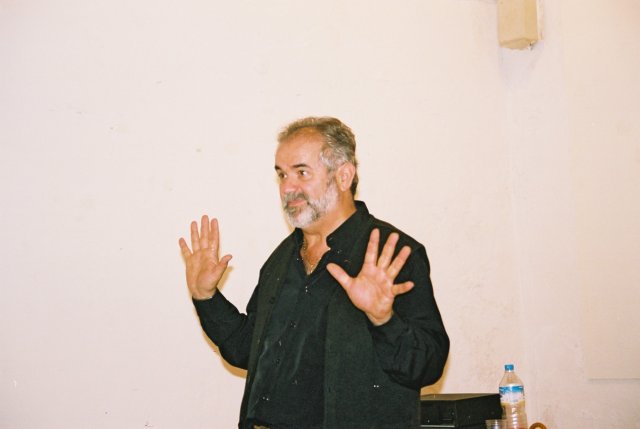
The next item was a talk by Marc Dubin of London, entitled "Considerations in the Compilation of a Rebetika CD". Marc described the complexities of producing a CD that attempted to encompass the whole range and history of Rebetiko. Just getting the copyright holders of all the tracks to allow them to be used is a major feat. Given that exposure on a compilation is likely to make the original CD sell more copies, it is surprising how much resistance there was from the other recording companies. This was far from being the only difficulty! The CD is called "Rough Guide to Rebetika", and I bought a copy soon after it came out. It's very good, and you can get it from Amazon for rather less than the price the guy trying to sell it on eBay keeps asking.

Marc's item was followed by Hugo Strötbaum of the University of Nijmegen, Holland. His contribution was called "Never heard of Doctor J. K. Sutherland, ud-player and makam-specialist from Flint, Michigan....?" Hugo collects records, and found the reference to Dr Sutherland in a puzzling place. His description of how he tracked down the mysterious oud player and his recordings is worth listening to, and too complex for me to include here, even if I could remember every step. So buy my CDs of the conference...

Cahit Baylav of London, gave his contribution on modal music. He described the use of makams in Turkish music, both in the Ottoman tradition and in more recent music. Makam music is not "well tempered" in the way that Western music is. Throughout his talk, he illustrated his points by playing the violin. The actual examples made the whole thing much easier for those such as myself, who don't do much in the way of proper music theory. Hearing a note "flattened by a comma" is a whole lot better than trying to imagine what it might be like!
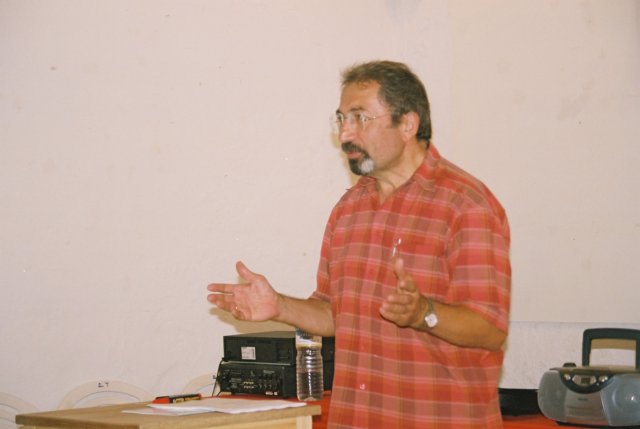
Then John Plemmenos gave a paper on "The Makam Concept in Phanariot Music", which was also very good. I forgot to make any notes about this contribution, or the ones that followed, so the rest of this page is going to be a little less detailed than I would have liked. (I don't have a suitable photograph of John to put here either, sorry.) However, if you want to listen to the sessions as they actually happened, you can obtain recordings from me for what amounts to a nominal sum.
Nikos Politis of Athens, Greece gave a paper on Amanedhes. He has translated it into English since the conference, and it should be available on Ed's site.

My seat had been gradually deforming until it sloped forward almost enough to force me to slide off it, so I was delighted to hear that the remainder of the day's sessions would be in the Bratsera Hotel, which has a conference room with much better seats. Instead of dining luxuriously, I dashed to the bakery for some pizza, and back to my hotel to recharge the Archos.
The first session on Friday evening, in the Bratsera, was presented by Stavros Stavrou Karayanni of Nicosia, Cyprus, and was entitled "Grammar and Politics of Dance: The case of the Tsifteteli". The title is a little dry. Ed Emery's site includes this summary, of the contribution, which is also a little dry and academic. However, Stavros succeeded in bringing the session to life by demonstrating the tsifteteli, rather well...
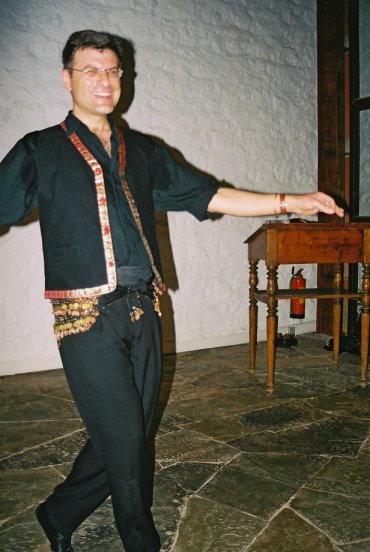
To follow that was not easy! However, Jason Melissinos and his shadow theatre were on next. The volunteer orchestra prepared themselves...
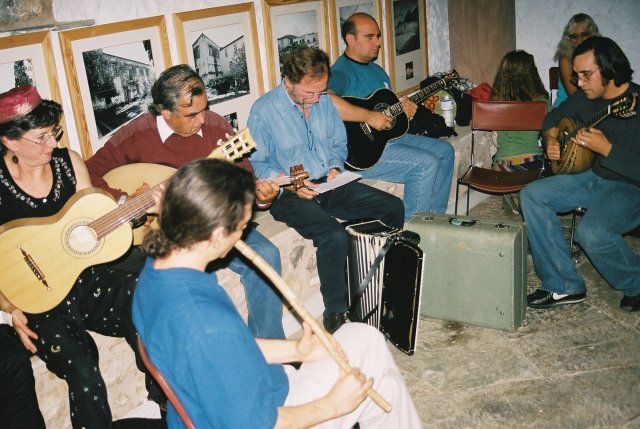
...the show, entitled "Karaghiozis o sfoungaras" (Karaghiozis the sponge fisher) began...

...and the lights, which had been flickering from time to time, went out. Another power cut. Of course, Jason is a professional, and the show went on with the aid of torches. The orchestra was also able to continue, having none of those modern electrical instruments...
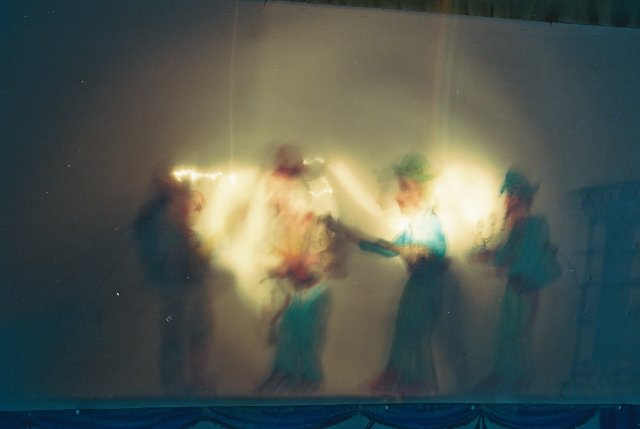
The lights came back before the end of the show. It must be warm work, back behind the screen.

This was followed by a showing of a new film by George Zervas of Athens, entitled "They tell me not to love you: the songs of Smyrna and Constantinople". I did not see this film, but others who did told me it was very good and very sad. George Zervas also made the famous film about Markos Vamvakaris, "I like hearts like mine", which for some strange reason is ludicrously expensive to buy on video, and not available at all on DVD.
Later I went to To Steki for dinner, and some ouzo. Musicians were there in force, and I recorded over an hour of music before heading off to bed. For a while, I thought the Archos had thrown this recording away, but it had not, to my great relief, as it was a good session. Here is a sample...