This is a word for what was once called a "spiv" in English. A tough, dope smoking mangas, in fact.
Aman aman!At its simplest, "Aman" translates as "Alas!" It appears a lot in Rebetiko songs, and particularly often in Smyrneika, in songs called amanadhes. There is a lot that can be said about it, and you will be hard pressed to find anything more thorough than Gail Holst-Warhaft's excellent "Amanes: The Legacy of the Oriental Mother", so I won't go on about it at length. A paper by Nikos Politis on the subject should also be available, but I have not been able to track it down.
Arghile
 |
This is the Greek name for the narghile, hookah, or hubble-bubble pipe, mostly used to smoke flavoured tobacco, but also used to smoke hashish. Many of the Greek hashish songs mention this device, often affectionately. See also Narghile in Wikipedia. The plural is arghiledes. | |
The Baglama is a half-size bouzouki. I have a whole page about the baglama. The baglama is often referred to fondly as "baglamadaki mou", which means my little baglama. The plural is "baglamades".
Begleria
 |
Begleria are a type of worry bead found in some parts of Greece, which consist of a single chain with two ends, instead of a having a loop, like komboloi. |
A gambling game, played with dice. Mostly, when these games are referred to, somebody is getting cheated.
Belas / Belalis.Belas is the Turkish word for trouble, and Belalis means "trouble-maker".
BochoriThe Bochori is a dance performed to a famous Rebetiko song called "Bochori". More than this I am unable to tell you.
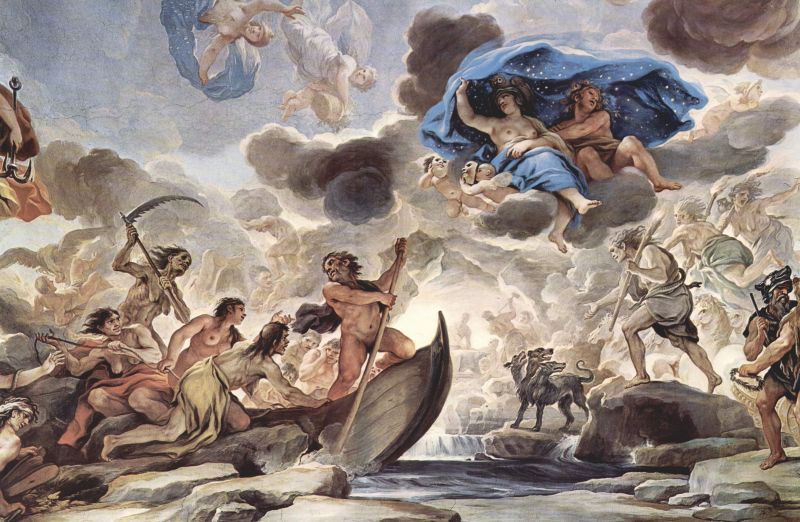
CharonCharon was the ferryman who carried the dead across the river Acheron to Hades.
 |
According to Wikipedia, the word Dervish, especially in European languages, refers to members of Sufi Muslim ascetic religious fraternities, known for their extreme poverty and austerity, similar to mendicant friars. As Sufi practitioners, dervishes were known as a source of wisdom, medicine, poetry, enlightment, and witticisms. The Manges called the places they smoked in tekes, after the name of the places these religious fraternities met in, and called themselves dervishes as well. In the event of hearing a particularly nice bit of bouzouki playing, a mangas might call out "Gia sou, Markos, Dervisi!" High praise, you might say... |
Gazohori was a district of Athens, where the gas-works was located. The name is derived from the words for "gas" and "village". It was probably not one of the nicer parts of Athens.
Gia sas! / Gia sou!Gia sou or Gia sas has many meanings. It can mean hello, goodbye, good health to you, cheers, and more. It is generally used in Rebetiko to praise a performer for some particularly inspired playing or singing. Sometimes the performer will say it themselves. A call during a performance is refered to as a tsakismata, although this word appears to have other meanings as well.
Kalami
|
The kalami, sometimes called the kalamaki, is a part of an arghile. The word means reed, and can refer to both the vertical pipe holding the loulas and the pipe from the side of the arghile. Kalami, kalamaki - this is a good example of the diminutive form of a noun being used to refer to a thing in an affectionate way. | |
Karaiskakis was a slum area next to Pireas Harbour. It was named after a revolutionary hero, and almost anything could be bought there, especially drugs. Nowadays there is a large square there.

My Oxford Dictionary of Modern Greek says only that kefi is "good mood, gaiety, gusto". That's a bit too bland, perhaps. A better description would be a feeling that one has that can only be expressed by dancing, singing, or simply radiating happiness. The strange custom of smashing plates that one had paid extra for was considered an expression of Kefi, though many of the older Rebetes disapproved of the waste and the flaunting of surplus money.
Komboloi
| The usual type of Greek "worry beads", which come in the form of a loop. You will quite often hear a set of Komboloi being tapped against a glass in recordings, to accentuate the rhythm of the song. |  |
A leventis is a fine, upstanding fellow; a brave or generous man.
Loulas / Loulades
|
The loulas (plural loulades) is the clay bowl at the top of the narghile. The word loulas literally means bowl. It often appears in expressions that mean something like "Let's smoke a couple of bowls!" | |
 Ah, mangas! Mangas is a word that appears everywhere in works about Rebetiko. Its plural
is manges. Gail Holst says in a footnote in "Road to Rembetika" that the manges were
men who formed a sub-culture on the fringe of society. Many of them were actually in the
underworld. The nearest equivalents in English are probably "spivs", "wide-boys" or
"hep-cats". Nowadays it is often translated as dude, but that's a word whose meaning
has changed over the years. Once you have encountered the word mangas in context a few
times, you may decide, as I have, not to translate it, but to accept it as a word in its
own right. Suffice to say, a mangas was somebody you would not mess with, unless you were
sure you were tougher than him.
Ah, mangas! Mangas is a word that appears everywhere in works about Rebetiko. Its plural
is manges. Gail Holst says in a footnote in "Road to Rembetika" that the manges were
men who formed a sub-culture on the fringe of society. Many of them were actually in the
underworld. The nearest equivalents in English are probably "spivs", "wide-boys" or
"hep-cats". Nowadays it is often translated as dude, but that's a word whose meaning
has changed over the years. Once you have encountered the word mangas in context a few
times, you may decide, as I have, not to translate it, but to accept it as a word in its
own right. Suffice to say, a mangas was somebody you would not mess with, unless you were
sure you were tougher than him.
|
The mapa, or marpoutsi, is the mouthpiece of the arghile. It is detachable, and smokers would often have their own. | |
Mavro means black. Some kinds of hashish are black, and quite sticky. This is another example of drug-users' argot, intended to keep the meaning of what is being said from anyone who might overhear. Mavraki has the diminutive ending, indicating affection for the black stuff.
Meraki / Meraklides / MeraklouA meraklida is a person who has meraki, which is described as a passion, a special taste. The meraklis demands the best, and relishes it. It can also mean a person who loves to do a job well.
MortisSomebody who lives day by day, without making any plans.
MoschomangasMoschos means fragrant, it's the word "musk" is derived from. The meaning of Moschomangas is something like a fine guy.
MourmourisNow, a mourmourisma is a mumble, so a mourmouris is one who would mumble, a very softly-spoken mangas. Some say the word came from those who habitually mumbled in a low voice (in jail, or maybe in other situations) to avoid being overheard. Naturally, all the usual changes of ending can happen, so a mourmouraki is a little mumbler, which is to say a mumbler you happen to like.
Nichta Organa

| This one had us scratching our heads until Nikos Politis told us the answer. The first word looks like the modern Greek for night - night instruments? No. The stress is on the last syllable, not the first. That first word comes from the Ancient Greek for "to scratch", and the phrase means plucked instruments. |
My two Greek dictionaries have no definition of this word, which one often hears shouted out during Greek music, both by performers and the audience. Basically, it is an expression of delight at the righteousness of the performance one is experiencing.
PaidiaThis word means "children", however, it's actually how Greeks address their group of friends, or parea. Usually, you will see the phrase "vre paidia".
PeniaLiterally, the penia is the pick used to play the bouzouki, but the word can also mean a string of notes, a style of picking, or something like a "lick" in guitar playing.
Po po po!You will hear this a little, or a lot, depending on your behaviour. It expresses disapproval and is more or less equivalent to "Tut tut". The number of "Po"s may indicate the level of disapproval.
Preza
 Preza is a slightly unspecific word, that usually, but not always, refers to
cocaine. Its literal meaning is "a pinch", and my dictionary says "as in a pinch
of salt". In fact, it is used to refer to substances that were sniffed up the user's nose in
pinch-sized amounts, but we are not talking about snuff here. Don't try this at home, kids!
Preza is a slightly unspecific word, that usually, but not always, refers to
cocaine. Its literal meaning is "a pinch", and my dictionary says "as in a pinch
of salt". In fact, it is used to refer to substances that were sniffed up the user's nose in
pinch-sized amounts, but we are not talking about snuff here. Don't try this at home, kids!
The word prezakias means one who has a preza habit, that is to say, a Junky.
ProusaProusa is the name of a place in Turkey, also known as Bursa, which was supposed to be the source of the best quality hashish. The word Prousalia refers to hashish from Prousa.
RakiRaki is a very strong, clear, alcoholic drink. Raki is one of those drinks that can make you say "Never again", and mean it. In Crete, it is called Tsikoudia.
SimansiI'm not sure about this one. One of the fine people who have helped me with this work says it was a women's prison, and another says it is a police department that deals with the taking and recognition of fingerprints.
TekeA teke was a small, not particularly legal, place where one could go to smoke hashish and play music in the company of others with the same interests. The plural is tekedes.
Tourne
- In the Turkish song "Neva Ouchak Canto - Tourna" (available from www.sealabs.org), Hafiz Yaschar Bey sings "Tournam, tournam". I'm told this refers to the crane (bird), which is apparently a frequent motif in Anatolian folk song.
- The Oxford Dictionary of Modern Greek says Tourne is a theatrical tour, and says it is from the French word tourneé.
- Azythos says "tournez", probably from ballroom dance schools, was used like "opa", when someone was drunk enough to stand up and dance.
 |
I invite you to take your pick. |  |
The Volta was once a dance, of a somewhat naughty nature, ending in a very close embrace, but the Greek Volta is the evening stroll around the town, once the heat of the day has gone. One dresses decently, and then ambles, looking at shops (which have re-opened after the siesta), meeting friends, visiting cafes, selecting a taverna for the evening meal and so on. I cannot imagine a more civilised way to spend the start of the evening.
Vre
 |
int. (fam.) unceremonious mode of address or cry of surprise, impatience etc | |
That's what the Oxford Dictionary of Modern Greek says about the word. It can fill the place "man" used to occupy in hippy-speak. Or "mate" in bloke-talk. But it can also be "What was that?" and half a dozen other meanings. So, yet another word with no exact translation, then.
We ate wood
 |
Why would anyone eat wood, you might wonder? Starvation, perhaps? No! This fascinating expression actually means that the guys were hit with wooden truncheons... | |
 Many Rebetiko songs are described as being in Zeibekiko
rhythm. The name is used to refer to a number of rhythms with a 9/8 pattern.
Many Rebetiko songs are described as being in Zeibekiko
rhythm. The name is used to refer to a number of rhythms with a 9/8 pattern.
Zeybekiko is also a dance that a mangas might well perform after a session with the arghile. The name comes from the Zeybek warriors who originated in an area that is now part of Turkey.
| Some Zeibekiko rhythms | |
 | Kamilieriko |
 | Heavy |
 | Aptaliko |
 | Aptaliko |
 | Aptaliko |
 | Aptaliko |
 | Aptaliko |
 | Aivaliotiko |