Agapios Tomboulis
 There is very little documented information on this outstanding exponent of the Oud.
Tomboulis was born to Armenian parents in Constantinople, circa 1891. Like many of Roza's
associates, he came to Greece as a refugee in September 1922 after being expelled from
Asia Minor. Tomboulis was Greece's leading Oud player and he can be heard performing
magic on hundreds of sides. He became a close associate of Roza's and she believed him
to be the best Oud player and a very good singer too. Apart from performing alongside
her throughout the 1930s at Taigetos taverna, he travelled extensively with Roza in
the Balkans and Near East before World War II; and again to Constantinople in the 1950s
where they cut approximately 40 sides. He died in Athens circa 1965.
There is very little documented information on this outstanding exponent of the Oud.
Tomboulis was born to Armenian parents in Constantinople, circa 1891. Like many of Roza's
associates, he came to Greece as a refugee in September 1922 after being expelled from
Asia Minor. Tomboulis was Greece's leading Oud player and he can be heard performing
magic on hundreds of sides. He became a close associate of Roza's and she believed him
to be the best Oud player and a very good singer too. Apart from performing alongside
her throughout the 1930s at Taigetos taverna, he travelled extensively with Roza in
the Balkans and Near East before World War II; and again to Constantinople in the 1950s
where they cut approximately 40 sides. He died in Athens circa 1965.
Panagiotis Toundas
 Panayiotis Toundas was born in Smyrna in 1885/1886. His family were fairly wealthy. From an
early age he learned to play the Mandolin, as well as other instruments. Around the turn of
the century he joined "The Politakia" - a Smyrna ensemble run by Sideras. He worked
alongside the greatest musicians in Asia Minor including Ogdhondakis, Papazoglou and Spiros
Peristeris. Toundas started to compose songs from 1910 approx. Many of his songs were
recorded and became hits prior to 1922, and he was instrumental in defining the Smyrnaic
sound. He also toured extensively in Egypt, Africa and Europe. He came to Athens in 1923 and
lived in the Nea Smyrni area. At first Toundas worked as a mandolin player in taverns but in
1924 he became a director of Odeon record company. His first composition to appear on 78RPM
in Greece was "Smyrnia" in 1924 sung by the tenor Misailidi. Toundas' compositions became
very popular and were leased to all the foreign record labels.
Panayiotis Toundas was born in Smyrna in 1885/1886. His family were fairly wealthy. From an
early age he learned to play the Mandolin, as well as other instruments. Around the turn of
the century he joined "The Politakia" - a Smyrna ensemble run by Sideras. He worked
alongside the greatest musicians in Asia Minor including Ogdhondakis, Papazoglou and Spiros
Peristeris. Toundas started to compose songs from 1910 approx. Many of his songs were
recorded and became hits prior to 1922, and he was instrumental in defining the Smyrnaic
sound. He also toured extensively in Egypt, Africa and Europe. He came to Athens in 1923 and
lived in the Nea Smyrni area. At first Toundas worked as a mandolin player in taverns but in
1924 he became a director of Odeon record company. His first composition to appear on 78RPM
in Greece was "Smyrnia" in 1924 sung by the tenor Misailidi. Toundas' compositions became
very popular and were leased to all the foreign record labels.
In 1929 Toundas discovered Roza Eskenazi singing in Tsitsifies and he arranged for Roza to record some sides, kick starting her recording career. They continued to work together successfully throughout the 1930s. In 1931, Toundas became director of the Columbia label. His songs continued to be amongst the most popular and he worked with the greatest musicians and singers of the day. From 1934, Toundas began to use bouzouki and baglama in recordings of songs. He continued his illustrious career through to 1941 when the Germans entered Athens. Toundas died on 23 May 1942 in his house in Nea Smyrni. He was survived by his wife and one daughter. Toundas ongoing popularity is shown not only in the ongoing re-releases of his original recordings, but also in the esteem in which he is held by Greek musicians today. His songs have been re-recorded by Alexiou, Glykeria, Ntalaras etc. When interviewed in 1972, Roza Eskenazi said that Toundas was the greatest composer of them all and she acknowledged his part in her story "If it weren't for Tountas, there would be no 'legendary Roza'".
Iovan Tsaous
 Iovan Tsaous was born near Konya, Turkey in 1896. His real name was Iannis Eitziridis.
His reputation was established by the time he was 18; he is said to have performed with
singing star Hafis Burhan Sesiylmaz for Sultan Hamit. In 1922 or 23 he migrated to Piraeus
and worked as a tailor, refusing to become a full time musician because he "didn’t want
to play for whores." Tsaous made a few records of his own tunes set to lyrics by his wife
Aikaterini.
Iovan Tsaous was born near Konya, Turkey in 1896. His real name was Iannis Eitziridis.
His reputation was established by the time he was 18; he is said to have performed with
singing star Hafis Burhan Sesiylmaz for Sultan Hamit. In 1922 or 23 he migrated to Piraeus
and worked as a tailor, refusing to become a full time musician because he "didn’t want
to play for whores." Tsaous made a few records of his own tunes set to lyrics by his wife
Aikaterini.
Vasillis Tsitsanis
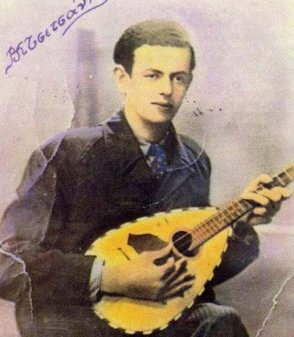 Vassilis Tsitsanis was born on January 18, 1915 in Trikala, Greece, the son of an Eipirot
shoemaker. His father played the mandola and at age twelve Tsistanis began to teach
himself the instrument. While at the local high school he also learned violin and
received lessons from Mr. Giosa, the Italian music teacher.
Vassilis Tsitsanis was born on January 18, 1915 in Trikala, Greece, the son of an Eipirot
shoemaker. His father played the mandola and at age twelve Tsistanis began to teach
himself the instrument. While at the local high school he also learned violin and
received lessons from Mr. Giosa, the Italian music teacher.
In 1935 he moved to Athens intending to study law. Word went around town that "a hick's in town who plays pretty fair bouzouki," and through the good offices of the singer Dimitris Perdikopoulos he was introduced to Spiros Peristeris, recording director at Odeon, and cut his first record (ca. Jan. 1936). Over the next two years he made a few more sides, but his recording career really took off in late 1937 when he returned to the Odeon studios with Perdikopoulos to record "Olo Ta Echo Varethi." From then until late 1940, when the second World War put an end to recording in Greece for over five years, he recorded 80 sides; traveling down to Athens to record during 1938 and early 1939, on brief leaves from doing his military service in Thessaloniki. After the war he re-located to Athens, and when recording finally recommenced in June 1946 he was one of the first to return to the studio.
Many years of success and a stream of memorable songs were to follow. He continued working virtually non-stop until December 22, 1983. A few days later he traveled to London and entered the Brompton hospital for tests. After an operation which seemed to have gone well his condition suddenly deteriorated and he died there on January 18, 1984 - his birthday.
Marika Franceskopoulou
 Known as "I Politissa", she was born in Constantinople, probably around the turn of
the 20th century. Like Marika Papagika, she was one of the first recorded-women
singers of the Smyrnaiko style of rebetiko tragoudi. The earliest records of her
are available in the E.M.I. archives in Hayes, Middlesex, England. They show that
she made a recording of the well known song, "Yi'afto foumaro cocaini", in Athens,
in October of 1932.
Known as "I Politissa", she was born in Constantinople, probably around the turn of
the 20th century. Like Marika Papagika, she was one of the first recorded-women
singers of the Smyrnaiko style of rebetiko tragoudi. The earliest records of her
are available in the E.M.I. archives in Hayes, Middlesex, England. They show that
she made a recording of the well known song, "Yi'afto foumaro cocaini", in Athens,
in October of 1932.
Manolis Hatzidakis
Manolis Hadjidakis was born in Heraklion, Crete in 1909, and became a famous Greek composer, though he was not a composer of Rebetiko. He studied at the University of Athens, where he graduated in 1933 and took his PhD in 1942. On 31st January 1949 he gave the famous "Hatzidakis 1949 Lecture about Rebetiko" at the "Art Theatre", which included performances by Markos Vamvakaris and Sotiria Bellou. I don't know if these performances were recorded.
Apostolos Hadzichristos
 Apostolos Hadzichristos was born in Kokariali, Smyrna in 1901, and died on the 5th of July
1959 in Athens, where he had lived since 1922, when he came to Greece. In 1922, still in
Smyrna,he marched in the Greek army as a volunteer, and was captured by the Turks. He saved
his live by escaping the very day of his execution. He played bouzouki, guitar, piano and
accordion. He performed in all the famous venues of the time, Derempei, Pikinou, Katelanou,
Dasos tou Vlahou. Exile, prison, his escape, his oriental origins, the problems of a hard
life, these were the inspiration for his songs.
Apostolos Hadzichristos was born in Kokariali, Smyrna in 1901, and died on the 5th of July
1959 in Athens, where he had lived since 1922, when he came to Greece. In 1922, still in
Smyrna,he marched in the Greek army as a volunteer, and was captured by the Turks. He saved
his live by escaping the very day of his execution. He played bouzouki, guitar, piano and
accordion. He performed in all the famous venues of the time, Derempei, Pikinou, Katelanou,
Dasos tou Vlahou. Exile, prison, his escape, his oriental origins, the problems of a hard
life, these were the inspiration for his songs.
Yiannis Halikias
 Yiannis (or Ioannis) Halikias, also known as Jack Gregory, was a Greek/American bouzouki
virtuoso. His 1932 "Minore tou Teke" was the first popular bouzouki recording, and was
a tremendous influence on the music being recorded in Greece.
Yiannis (or Ioannis) Halikias, also known as Jack Gregory, was a Greek/American bouzouki
virtuoso. His 1932 "Minore tou Teke" was the first popular bouzouki recording, and was
a tremendous influence on the music being recorded in Greece.
Rumour has it that he learned to play bouzouki against his father's wishes, tutored in the ways of the mangas by his uncle. When he moved to America he made a few recordings but became disillusioned by the record company and refused to record anymore. He found he had signed an exclusive contract with the company for thirty years!
There's talk of Halikias running an underground hashish joint in the 30's and being involved in other shady activities, living the life of a mangas in America. Many famous musicians would visit Halikias when they were in New York, and there are unpublished recordings of Halikias with them.
Stella Haskil
 Stella Haskil was born in Thessaloniki in 1918, and began her recording career after World
War II. She sang with artists such as Markos Vamvakaris, Apostolos Hatzichristos, and
Stellakis Perpiniadis, though she is best known for her work with younger artists such as
Vassilis Tsitsanis and Apostolos Kaldaras. Her most famous recording is her 1947 version
of the song "Nichtose Horis Fengari" (Night Fell Moonless), written by Kaldaras during
the Greek civil war which lasted until the end of the decade. The original title of this
song was "Nichtose sto Gendi" ("Night fell in Gendi" - the prison in Thessaloniki where
political prisoners were held). This song was such a success, that even though certain
verses were changed to meet the demands of the censors (who were always looking out
for any suspect political references), after a few days, it was withdrawn from circulation,
and its performance was banned. Tragically, Stella Haskil died on 27 February, 1954,
in Athens.
Stella Haskil was born in Thessaloniki in 1918, and began her recording career after World
War II. She sang with artists such as Markos Vamvakaris, Apostolos Hatzichristos, and
Stellakis Perpiniadis, though she is best known for her work with younger artists such as
Vassilis Tsitsanis and Apostolos Kaldaras. Her most famous recording is her 1947 version
of the song "Nichtose Horis Fengari" (Night Fell Moonless), written by Kaldaras during
the Greek civil war which lasted until the end of the decade. The original title of this
song was "Nichtose sto Gendi" ("Night fell in Gendi" - the prison in Thessaloniki where
political prisoners were held). This song was such a success, that even though certain
verses were changed to meet the demands of the censors (who were always looking out
for any suspect political references), after a few days, it was withdrawn from circulation,
and its performance was banned. Tragically, Stella Haskil died on 27 February, 1954,
in Athens.
Manolis Hiotis
 Manolis Hiotis was born on March 21 1920, in Thessaloniki and died on March 21, 1970.
Once cruelly described as "A guitarist who caused the tetrachordo to become popular", Hiotis was a virtuoso on many stringed instruments. He appears playing excellent trichordo bouzouki on several famous Rebetiko recordings, but moved to playing other styles, and is consequently mostly not thought of as a rebetiko player.
Stelios Chrisinis
 Stelios Chrisinis was born in Piraeus in 1916. He was the fourth child, after Mary,
Basil and Panayiotis, in a middle-class family. His parents were of Arvanite origin.
Stelios and his brother Panayiotis, who was six years older, both became blind at a
young age. They were taught violin, piano, guitar, lute, and mandolin which made it
easy for them to learn bouzouki and baglama. In the early 30's they became known for
their ability to reproduce the music and songs from various shows, revues, operettas
and became known within the circle of musicians. The composer Lefteris Gounaro said
he first heard them in the Vrioni bar in Piraeus in 1932 or 33. Stelios played
bouzouki and Panayiotis the guitar, and people were queueing to hear them.
Stelios Chrisinis was born in Piraeus in 1916. He was the fourth child, after Mary,
Basil and Panayiotis, in a middle-class family. His parents were of Arvanite origin.
Stelios and his brother Panayiotis, who was six years older, both became blind at a
young age. They were taught violin, piano, guitar, lute, and mandolin which made it
easy for them to learn bouzouki and baglama. In the early 30's they became known for
their ability to reproduce the music and songs from various shows, revues, operettas
and became known within the circle of musicians. The composer Lefteris Gounaro said
he first heard them in the Vrioni bar in Piraeus in 1932 or 33. Stelios played
bouzouki and Panayiotis the guitar, and people were queueing to hear them.
In 1934 Stelios recorded the song "Yesterday evening in our teke" (Columbia DG 21224), with Stellakis Perpiniadis. He worked with the famous violinists Demetrios Semsis (Salonikios) and Panagiotis Tountas. In the prewar years he worked with all the record companies. During the Occupation he worked in restaurants in the capital and elsewhere. He also taught singing and music; Stelios Kazantzidis was one of his pupils.
He died on February 14, 1970, from liver failure due to obesity and drinking.